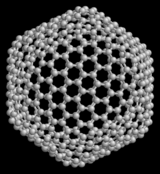
Full Clean is a family of carbon allotropes, molecules composed entirely of carbon in the form of a hollow sphere, ellipsoid, tube or plane. Spherical fuller's also known as bucky balls, and cylindrical them called carbon nanotubes or buckytubes. Grapher is an example of a planar format full clean sheets. Fuller's is similar in structure to graphite, which consists of stacked sheets of linked hexagonal rings, but may also contain pentagonal (or sometimes heptagonal) rings that would prevent a sheet from the planar format.
The full clean was discovered in 1985 by Robert Curl, Harold Kroto and Richard Smalley at the University of Sussex and Rice University who named it after Richard Buckminster Fuller, whose geodesic domes similar.
Prediction and discovery
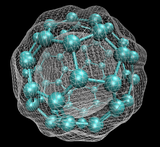 With mass spectrometry, discrete peaks were observed corresponding to molecules with the exact mass of sixty or seventy or more carbon atoms. In 1985, Harold Kroto (then of the University of Sussex), James R. Heath, Sean O'Brien, Robert Curl and Richard Smalley from Rice University, discovered the C60, and shortly thereafter came to discover the fuller. Kroto, curl, and Smalley were awarded the 1996 Nobel Prize in chemistry for their roles in the discovery of this class of compounds. C60 and other fuller agree later noticed occurring outside the laboratory (eg, in normal candle soot). By the end of 1991, it was relatively easy to produce gram-sized samples of the full pure powder using the techniques of Donald Huffman and Wolfgang Krätschmer. Full Rene treatment remains a challenge to chemists and largely determines the full clean prices. So-called endohedral fuller stocks have ions or small molecules incorporated inside the cage atoms. Full Rene is an unusual reactant in many organic reactions such as the Bingel reaction discovered in 1993. The first nanotubes were obtained in 1991.
Minute quantities of fuller's, in the form of C60, C70, C76 and C84 molecules that are produced in nature, hidden in soot and formed by lightning discharges in the atmosphere. Recently Buckminsterfullerenes was found in a family of minerals known as Shungites in Karelia, Russia. [citation needed]
The existence of C60 was predicted by Eiji Osawa of Toyohashi University of Technology in a Japanese magazine in 1970. He noticed that the structure of a molecule corannulene was a subset of a soccer-ball shape, and he put forward the hypothesis that a full ball shape could also exist. His idea was reported in Japanese magazines, but did not reach Europe or the USA.
Naming
Buckminsterfullerene (C60) was named after Richard Buckminster Fuller, a noted architectural modeler who popularized the geodesic dome. Since buckminsterfullerenes have a similar shape to that sort of dome, the name was thought to be appropriate. As the discovery of the fullerene family came after buckminsterfullerene, the shortened name 'fullerene' was used to refer to the family of fullerenes.

